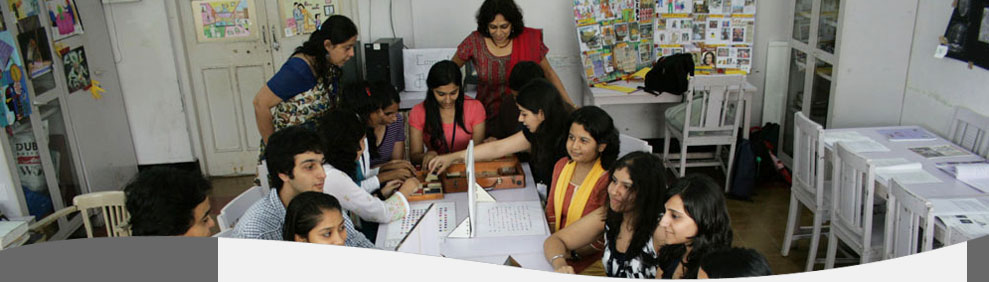
History of Department
-
The Department of English, Jai Hind College, is one of the oldest departments dating back to the foundation of the college in 1948. The first Head of the Department, Professor T.M. Advani, was also the Founder Principal of the college. The Department of English has always boasted of dynamic academicians and scholars, as well as talented and versatile alumni, all of whom have contributed to making it one of the most sought after departments in the city. The English Association, the cultural wing of the Department, regularly holds seminars, workshops, literary festivals and hosts talks by various eminent guest speakers from reputed universities across the world (such as the Universities of Cambridge and Stanford). We also stage a play at the end of each academic year, and the Department publishes a magazine ‘Hwӕthwugu’ annually. The Shakuntala Jagtiani award for excellence in English is awarded annually to deserving students. The Faculty members of the Department are also involved with the Literary and Debating Society of the college, funded by the University of Mumbai.
USP
We are a Department that balances out academics and research with a wide range of co-curricular and extra-curricular activities.
Student Profile
Results:
Our students have consistently performed well at the University examinations, earning places in the list of toppers: Gulnar Mistry, Pallavi Mogre, Saloni Bhatia and Gayatri Vishwanathan are some of them.
Achievers:
Many students of the Department are selected for scholarships offered by the Sumimoto Corporation, on the basis of the merit and all-round excellence. They are even selected for Summer exchange-programmes at King’s College, London (Likla Lal, Richa Gupta, Malvika Khatpal, Friyana Pardiwalla). Many students are pursuing higher studies and research degrees at reputed universities in India and abroad. Additionally, our students have carved a niche for themselves in diverse fields. Our alumni include: Shikha Talsania (Actor: Film and theatre), Shreyas Pardiwalla (Actor: Film and theatre), Aldish Edroos (Journalist, CNBC), Namrata Zacharia (Senior Editor, Indian Express), Alpana Ladh (Senior Editor,Mid-Day), Gina Billimoria (Senior Journalist, Hello! Magazine) and Varun Gwalani (Published author).
Learning Resources and Facilities available:
- A well-stocked Reference and Lending Library in the Main Building of the college, with multiple titles, numerous subscriptions and a Research Corner
- E-resources like online journals and Inflibnet, TED lectures, Youtube videos, and open courseware such as MIT Open Courseware
- A Department Library, which comprises of approximately 120 books, for the TYBA students. [attach catalogue link]
- Access to the Audio-Visual Room and technological facilities like Video-conferencing and the Smartboard in Room 219 of the Main Building of the college
- VCDs and DVDs available
- LCD Projectors
- Interactive Overhead Projectors in classrooms in the Annexe Building
- LAN (Local Area Network) allowing file sharing as well as access to the library server
- Wi-Fi connectivity
- Library internet connectivity
- Workshops organized by the Teachers’ Academic Forum (TAF) for teachers
Modern Teaching Methods
Teaching is student-centric and enables various kinds of learning such as:
- Collaborative Learning: This is done through assigning group projects and assignments, notably in the courses of ‘Effective Communication Skills in English’ and ‘Business Communication’.
- Participative Learning: This is an integral part of our teaching-learning process, enabled by creating interactive sessions through discussions, debates, role-play and quizzes. Tutorials are conducted in the ‘Effective Communication Skills in English’ and ‘Business Communication’ courses.
- Experiential Learning: Students experience learning through innovative practices such as film screenings, language games, field-trips (for instance, to the American Information Resource Centre) and discussions on books.
- ICT and e-learning: We have Power Point Presentations. We screen videos of advertisements. E-resources in the library, connected classrooms (through LAN and Wi-Fi) and Open Courseware facilitates the learning process and ensures students learn at their own pace.
Our methods
- Interactive teaching
- Use of technological facilities like overhead projectors
- Use of the Audio-Visual Room
- Guest lectures
- Seminars
- Workshops
- Screenings of films, documentaries, videos and advertising
- Power point presentations
- Group Discussions
- Class Presentations
- Language Games
Visits from Eminent Personalities to the Department
- Special Guest Lectures
- Tenzin Tsundue, (Tibetan activist/ writer, Dharamshala)
- Menka Shivdasani (Indian writer)
- Laxmi Hariharan (Indian writer)
- Professor Valerie Miner (Stanford University)
- Professor Rani Drew (Poet and playwright, Cambridge University)
- Professor John Drew (Poet, Cambridge University)
- Prof. Rochelle D’Souza, (NYU),
- Prof. Susan Harris, (Univ. of Kansas)
- Dr. Mala Pandurang, (Vice-Principal at Dr BMN College, Fulbright Professor)
- Michelle Philip, (HOD, English, Wilson College)
- Representatives of the Krantijyot Savitribai Phule Women’s Studies Centre, Pune
- Workshops:
- Drama and Theatre (Anahita Uberoi)
- Shakespearean Drama (Alyque Padamsee)
Noteworthy Publications and Paper Presentations
Dr. Kamal Jadhav: 4 papers in an ISSN journal, 1 book
Publications
ISSN No 2249-7471
1)Archetypal Images in Partition Literature TAF Journal 2009
2)Diaspora of Forced Exile TAF Journal 2011
3)Marginalised Voices of the Partition TAF Journal 2012
4)Politics of Partition TAF Journal 2014
Book
“The Partition of India – A Literary & Historical Perspective”
ISBN No 1499729498-9
Dr. Prachi Khandeparkar:
1 Research Fellowship Project and 3 Publications
Research Project and Publications:
Post-doctoral Research Project in Comparative Literature, titled The Making of Marathi Literary Theory during the Colonial Era was accepted by the Indian Institute of Advanced Study, Shimla in 2010-11
Publications by National level Publishers:
Sole author:
The monograph which was the result of the year-long research fellowship titled Bringing Modernity Home: Marathi Literary Theory in the Nineteenth Centurywas accepted for publication by the IIAS, after a review process, in 2012. (ISBN: 978-93-82396)
Chapter in a Book
The paper ‘Carving Out a Region Beyond: Religious Violence in Partition Narratives’ was accepted for publication in an anthology The Weight of Violence: Religion Language Politics (ed.s) Saitya Brata Das and Saumyabrata Choudhury, by Oxford University Press in March 2014.
Paper in a Refereed Journal:
‘Through a Changing Feminist Lens: Three Biographies of Anandibai Joshi’ was accepted by Economic and Political Weekly, in May 2014. EPW is indexed on Scopus, published by Elsevier, which is the world’s largest abstracts and citations database of peer-reviewed literature. (Vol. XLIX, issue 33)
Dr. Seema Sharma: 5
1 Book, 2 Papers and 2 Translations
Book
Articulating Resistance in African American Slave Narrative. Delhi : Mittal Publication, 2012.
Articles and Essays
- ‘Enlightenment Rhetoric, Resistance and Self creation in The Life of Olaudah Equiano’, TAF Journal,Vol. 2, June 2011.
- ‘Teaching Things Fall Apart in India - Students’ Response and Pedagogical Strategies’, TAF Journal, Vol. 1, January, 2009.
Translation (From Hindi to English)
- Translation of Kamleshwar’s story titled `Chappal’, Indian Literature, Sahitya Akademi’s Journal, March/April 2014.
- Translation of Sudha Arora’s short story titled ‘You will never change’, Indian Literature, Sahitya Akademi’s Journal, Sep/Oct 2013.
Ms. Deepna Rao: 2
Publications
- Published ‘A Consideration of Language in Achebe’s Things Fall Apart’ in ‘Reading Things Fall Apart: A Students’ Companion’ (ed.) Mala Pandurang, published by Pencraft International, New Delhi, 2015 (ISBN: 978-93-82178-05-7) (Pages 81 – 91)
- Co-wrote a paper with Professor Mala Pandurang entitled ‘Reading Vassanji’s Women: Across time, location and interstitial identities’; presented by Professor Pandurang at ‘The Transnational Imaginaries of M.G. Vassanji’ at The School of Oriental and African Studies (S.O.A.S.), London, U.K. (November 10, 2013). Programme Link: https://amtez.net/mgv/?page_id=2 [Paper published as conference proceedings]
Ms. Anamika Purohit: 2
Publications
- Published a paper titled “Reterritorializing Space-Race: A Gendered and Corporeal Reading of History and Space in Susanna Nicchiarelli’s Cosmonauta” in Media Research And Communication Journal - Volume II, July 2015 [ISSN 2394-7594]
- Published a paper titled “The Place of the Abject: Locating a Dalit Spatiality in Selected Poems of Namdeo Dhasal” in Asian Journal of English Studies – Volume No. 4; Issue No. 2 – April 2015 [ISSN 2277 – 3606]
Goals Realized
- Three National Conferences/Seminar
- Subject-oriented Department activities like the ‘Popular Culture Fest’.
- Inviting and hosting various eminent personalities
- Hosting a syllabus-revision workshop in collaboration with the BOS, English
Future Plans
- A Postgraduate Centre
- Ph.D Centre Recognition for the Department
- More frequent interactions and exchange programmes with neighbouring colleges
- More interdepartmental activities
- Expansion of the Department Library
- Creation of an ‘e-book’ library
- Creation of a multimedia library
- Creation of a journal of professional excellence for teachers from English Departments across the city
- Incorporating Videoconferencing and Smartboards in teaching-learning practices
- Working towards foreign research collaborations and student-faculty exchange programmes
|
Faculty
Faculty Profile
Dr. Kamal Jadhav (Former Head of Department, retired wef 31st May, 2015) |
Assoc. Prof. |
MA, M.Phil, Ph.D (2007) |
Dr. Prachi Khandeparkar (VRS wef 17th October, 2014) |
Asst. Prof. |
M.A., Ph.D (2004) |
Ms. June Dias |
Asst. Prof. |
MA, SET, Pursuing Ph.D. (registered January 2013) |
Dr. Seema Sharma |
Assoc. Prof. |
MA, M.Phil, NET, Ph.D (2010) |
Ms. Divya Bhatnagar |
Asst. Prof. |
MA, NET |
New appointment: Ms. Deepna Rao |
Asst. Prof. |
MA, M.Phil, NET, Pursuing Ph.D. (registered January 2014) |
New appointment: Ms. Anamika Purohit |
Asst. Prof |
MA (Hons.), NET-JRF, Pursuing Ph.D. (registered January 2014) |
New appointment: Ms. Sharon Thekkekara (in a Leave Vacancy, in the place of Dr. Seema Sharma, for the Academic year 2015 – 16) |
Asst. Prof |
MA, NET, Pursuing Ph.D. (registered January 2014) |
|