

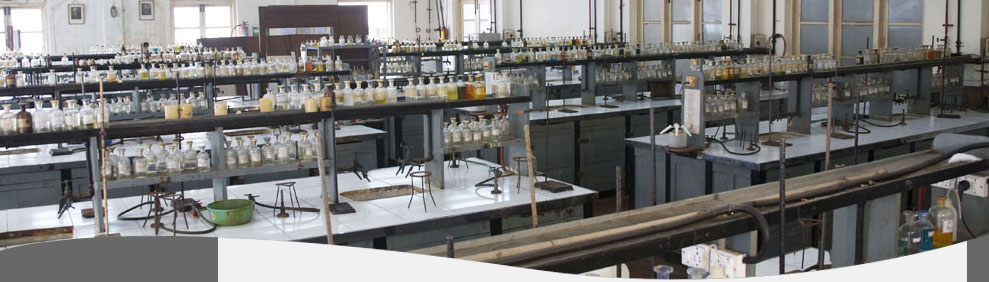

Chemistry DepartmentThe year 2011-2012 being the International Year of Chemistry, the focus of the department was to broaden the scientific temperament of teachers and students, alike. The students were encouraged to “think beyond” in the way of assignments as posters, static models and power point presentations as part of their curriculum. Teachers were encouraged to apprise themselves of the recent advances through submission of Minor and Major research projects, participation in seminars, workshops, paper and poster presentation in national and international reputed journals and Science Meets, and refresher and orientation courses as also clearing the mandatory NET examination. The students were encouraged to contribute towards Community Service through participation in Mini Marathon organized by the Terry Fox Foundation in aid of Cancer Patients. |
||||||||||||||||||||||||||||||||||||
Faculty of Department of Chemistry
|
||||||||||||||||||||||||||||||||||||
SyllabusClick here for Syllabus of F.Y.Bsc Click here for Syllabus of F.Y.Bsc Click here for Syllabus of F.Y.Bsc
Applied Component for Drugs & DyesSyllabus for Dyes (TYBSc) 2010 Unit – 1 1. Introduction to dyestuff chemistry (5L) 1. 1 Important landmarks in the history of dyes 1.1.1 Natural colouring matters and their limitations : eg. : Henna, Turmeric Kesar, Chlorophyll, Indigo, Alizarin from roots of madder plants, Logwood, Tyrian purple, Cochineal. 1.1.2 Important milestones in the development of the synthetic dyes : Mauve, Diazotization, Bismark Brown, Aniline Yellow, Congo Red, Indigo, Indanthrene. Disperse dyes. Fluorescent brighteners, Procion reactive dyes. Remazol dyes (emphasis on name of the scientist and the year of the discovery of dye. Structure is not expected). 1.2 Definition of dyes, properties i.e. colour,,chromophore, auxochrome, Solubility, linearity, coplanarity, fastness properties, substantity, economic Viability. 1.3 Explanation of nomenclature of commercial dyes with atleast one example.
Suffixes – G, O, R, B, 6B, GK, 4GK, 6GK, L, S 1.4 Brief idea of the important dye industry. 2. Classification of dyes based on constitution (4L) (Examples as mentioned below with structures)
3. Classification based on applications (6L)
Unit – 2 4. Colour and chemical constitution of dyes (5L) 4.1 Absorption of visible light, colour of wavelength absorbed, complementary colour. 4.2 Relation between colour & chemical constitution.
5 Non-textile uses of dyes (6L) Two examples with structures for each of the following) (1) Leather dyes (2) Paper dyes (3) Foodstuff dyes (4) Cosmetic dyes (5) Medicinal dyes (6) Biological staining agents (7) Indicators & analytical reagents (8) Coloured smokes & camouflage Colours 9) Laser dyes (10) Solvent dyes 6. Optical brighteners (2L) General idea, distinguish between dyes and pigments. Important characteristics of organic pigments, toners & lakes. Classification of organic pigments with suitable examples, i.e. Ionic pigments – lakes of acid and basic dyes, Nonionic pigments – azo, indigoids, anthraquinone, quinacridone, phthalocyanine (Copper phthalocyanine), Uses of pigments. Unit – 3 8 . Intermediates (11L) 8.1 A brief idea of unit processes 8.1.1 Introduction of primary intermediates, unit processes 8.1.2 (a) Nitration, (b) Sulphonation, (c) Halogenation, (d) Diazotization : 3 different methods, (e) Ammonolysis, (f) N- and O-alkylation, (g) Oxidation N.B. Definition, reagents, examples with reaction conditions (mechanism is not expected) 8.2 Preparation of the following intermediates. 8.2.3 Benzene derivatives : Benzenesulphonic acid, 1,3-benzenedisulphonic acid,Phenol, resorcinol, sulphanilic acid, o-, m-, p-chloronitrobenzenes, o-, m-, p-nitroanilines, o-, m-, p-phenylenediamines, picric acid. Naphthol ASG. 8.2.2 Naphthalne derivatives : α, β-Naphthols, a, β-naphthylamines, Schaeffer acid, Tobias acid, napthionic acid, N.W. acid, Clev-6-acid, H acid, Naphthol AS. 8.2.3 Anthracene derivatives : 1-Nitroanthraquinone. 1-aminoanthraquinone. 2 – aminoanthraquinone, 2 – methylanthraquinone, anthraquinone – 1 – sulphonic acid, anthraquinone -2-sulphonic acid, 1- chloroanthraquinone, 2-chloroanthraquinone : benzanthrone 9. Dyeing methods and forces of binding dyes to the fibres (4L) 9.1 Dyeing methods of cotton fibres (i) Direct dyeing, (ii) Vat dyeing, (iii) Mordant dyeing, (iv) Disperse Dyeing 9.2 Forces binding dyes to the fibres : Ionic forces, hydrogen bonds, Vander Waal’s forces, covalent linkages. Unit 4 10. Synthesis of specific dyes and their uses (12L) i) Orange IV from sulphanilic acid. ii) Tartrazine by using ethyl acetate and diethyl oxalate. iii) Eriochrome Black T from β – naphthol. iv) Eriochrome Black A from β - naphthol v) Eriochrome Red B by using ethyl accetoacetate and 1 –amino 2-naphthol-4-sulphonic acid. vi) Direct Deep Black EW by using benzidine. H acid, aniline, and m-phenylene diamine. vii) Congo Red from nitrobenzene. viii) Diamond Black F by using 5-amino salicylic acid, N.W. acid and a – naphthylamine. ix) Malachite Green by using benzaldehyde and N, N dimethylaniline. x) Auramine O from N, N dimethylaniline xi) Methylene Blue by using 4-amino-N, N dimethylaniline and N, N dimethylaniline xii) Afranine T by using p-toluidine and aniline xiii) Pararosaniline by using p-toluidine and aniline xiv) Alizarine Cyanine Green G by using phthalic anhydride and p-cholorophenol xv) Indanthrene from anthraquinone xvi) Disperse Yellow 6G from benzanthrone xvii) Indigo from aniline xviii)Thioindigo from anthranilic acid xix) Eosine by using phthalic anhydride and resorcinol xx) Bismark Brown from m-phenylenediamine 11. Types of fibres and classes of dyes applicable to it (1L) 11.1 Introduction to the following types of fibres with structures and classes of dyes applicable to it. Cotton, wool, silk, polyester. 12. Ecology and toxicity of dyes (2L) Syllabus for Drugs (TYBSc) 2010 Unit - I 1.1General Introduction To Drugs (6L) 1.1.Definition of a drug, requirements of an ideal drug, classification of drugs (based on therapeutic action) 1.2Nomenclature of drugs : generic name, brand name,systematic name. 1.1.4 Brief idea of the following terms: receptors, drug – receptor interaction, drug potency, bioavailability, drug toxicity, drug addiction, spurious drugs, misbranded drugs, adulterated drugs, Pharmacopoeia. 1.2 Routes of drug administration and dosage forms (2L) 1.2.1 Oral and parenteral routes with advantages and disadvantages. 1.2.2 Formulations, different dosage forms (emphasis on sustained release formulations). 1.3 Pharmacodynamic agents 1.5 Analgesic (Narcotics and Non-narcotics) and Antipyretics (2L) 1.6 Anti-inflamatory drugs (2L) 1.7 Antihistaminic drugs (2L) 1.8 Cardiovascular drugs (3L) 1.9 Antidiabetic agents (2L) 1.10 Antiparkinsonism drugs (2L) 1.11 Drugs For respiratory system (2L) 1.12 Mode of action of the following drugs (2L) Unit – II 2.1 Drug discovery design and development (5L) 2.2 Drug metabolism (3L) 2.3 Chemotherapeutic agent (3L) 2.4 Antibiotics (3L) 2.5 Antimalarials (2L) 2.6 Antiamoebic drugs (1L) 2.7 Anthelmintics (2L) 2.8 Antitubercular and Antileprotic drugs (4L)
Synthesis : (+) Ethambutol, Ethionamide, Dapsone. 2.9 Antineoplastic drugs (2L) 2.10 Anti HIV drugs (3L) 2.11 Drug Intermediates: Synthesis and uses (3L)
2.12 Nanoparticles in medicinal chemistry (4L) |
||||||||||||||||||||||||||||||||||||

